
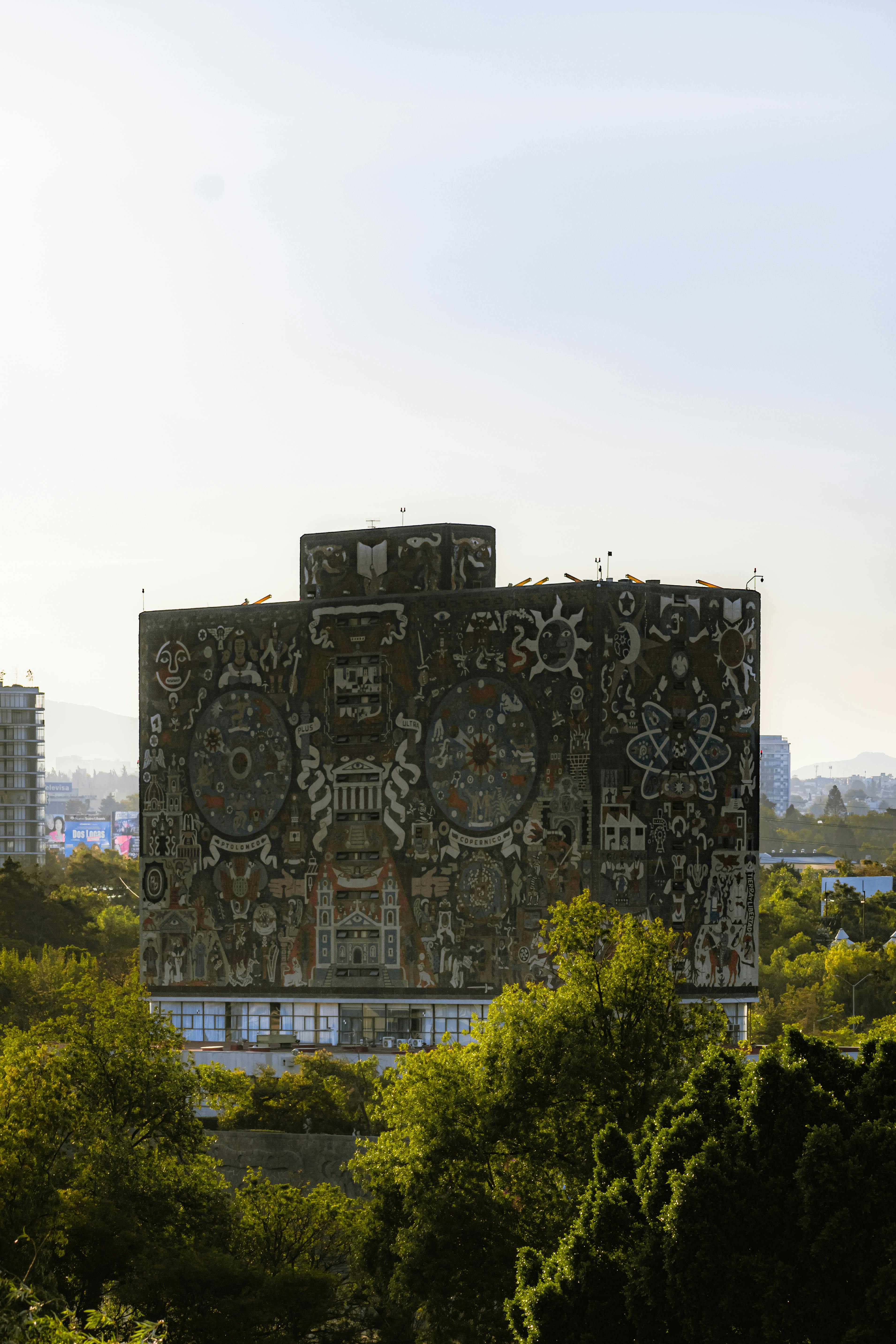

To speak of Juan O’Gorman is to speak of modern Mexico. His work accompanies us without us always knowing it: in libraries, museums, houses, murals, and even in unexpected corners. This year we celebrate 120 years since his birth, and this special edition begins by paying tribute to the man who knew how to unite thought, art, and form in every space he designed.
His most emblematic work, the UNAM Central Library, is a powerful synthesis of architecture and muralism, built with more than 4,000 square meters of natural stones that narrate the history of our country. It is undoubtedly one of the most recognizable buildings in Mexico City and one of the greatest works of plastic integration of the 20th century.
But O’Gorman’s legacy does not end there. Between 1931 and 1932, he designed the Diego Rivera and Frida Kahlo House Studio in San Ángel: two functionalist blocks joined by a bridge that, in addition to its structural function, is a symbol of one of the most iconic couples in Mexican art. With this project, O’Gorman introduced functionalism into Mexican architecture and turned it into art.
His vision also transformed public spaces. At the National History Museum, inside Chapultepec Castle, he painted the Altarpiece of Independence between 1960 and 1961, a monumental mural that brings together more than eighty key figures from the independence movement. With a critical and combative eye, he also depicted the people, ethnic groups, and injustices that marked our history.
At the Anahuacalli Museum, O’Gorman worked alongside Diego Rivera on an architectural tribute to pre-Hispanic culture. The technique he would later use in the Central Library, based on colored stone mosaics, was born here. More than a museum, it is a modern temple made of basalt, a fusion of tradition and modernity.
His architecture also had intimate and radical moments. In 1956, he built his Casa Cueva (Cave House) in Pedregal: an organic dwelling inspired by Frank Lloyd Wright and Mathias Goeritz, where stone, vegetation, and structure merged into a single form. Although it was destroyed, it is considered a lost gem of fantastic architecture. You can still visit the site where it stood, and a detailed model allows you to imagine it in its splendor.
Even popular spaces such as an old pulque bar in the Historic Center, known as “Los Fifís,” were touched by his hand. There, he decorated the walls with scenes of everyday Mexico, bringing art to the streets. Although his murals no longer exist, photographs and engravings keep them alive in cultural memory.
His legacy lives on in stone, but also in the eyes of those who
visit his houses, buildings, and museums.
And receive exclusive information to travel through Mexico in style!