
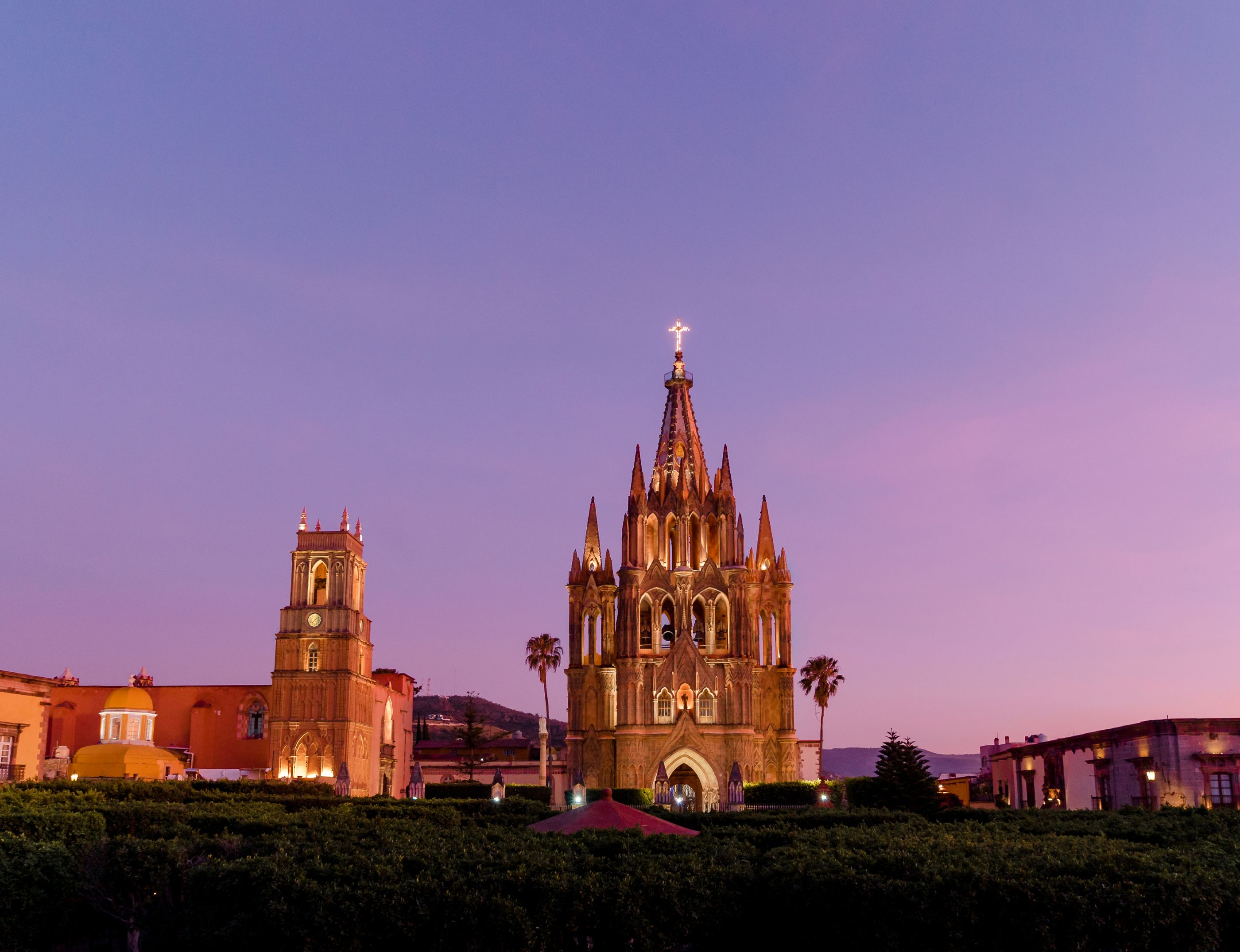

San Miguel de Allende is a setting where centuries dialogue in harmony. Founded in the 16th century to protect the Camino Real de Tierra Adentro—the legendary Silver Route—this jewel of El Bajío preserves a viceregal urban layout that reflects order, balance, and a deep relationship with the landscape. Its cobblestone streets and ochre facades echo the Baroque style of New Spain, which reached one of its most refined expressions here thanks to the region’s mining and commercial prosperity.
The Parish Church of San Miguel Arcángel, with its neo-Gothic pink stone façade designed by Zeferino Gutiérrez, dominates the skyline with its spire-shaped towers and pointed arches, becoming the visual and spiritual emblem of the city. Surrounding it, temples such as San Francisco, with its late Baroque ornamentation and richly carved façade, or Nuestra Señora de la Salud, with its octagonal dome and stone façade, showcase the virtuoso craftsmanship of local master stonemasons. The Casa del Mayorazgo de la Canal, with its sober neoclassical façade and elegant arcaded interior courtyards, represents the transition of styles, while the Ángela Peralta Theater and the Municipal Palace narrate the 19th-century splendor that transformed urban life.
Fourteen kilometers away, the Sanctuary of Jesús Nazareno de Atotonilco is a pictorial and spiritual universe. Its walls, covered with murals by Antonio Martínez de Pocasangre, form an illustrated Bible where devotion becomes art. Together with San Miguel, this site is a UNESCO World Heritage Site, recognizing the dialogue between faith, art, and architecture that defines the region.
Today, that dialogue continues in contemporary works that reinterpret the local essence. The Hotel Albor, by PRODUCTORA + Esrawe Studio, emerges from the ground with a stone base that evokes the bowels of the mountain. Quinta Amores, by Estudio IPA, celebrates the encounter between hospitality, landscape, and memory, while Restaurante Adela, by Faci Leboreiro, pays homage to regional stone and art with a lobby dominated by a sculptural loom by Mariella Motilla and a jacaranda tree that integrates into the interior as the living heart of the space.
San Miguel de Allende is thus a city where Baroque heritage and
contemporary design intertwine in a single narrative: that of a place that
not only preserves its history but reinvents it with each new dawn
And receive exclusive information to travel through Mexico in style!