
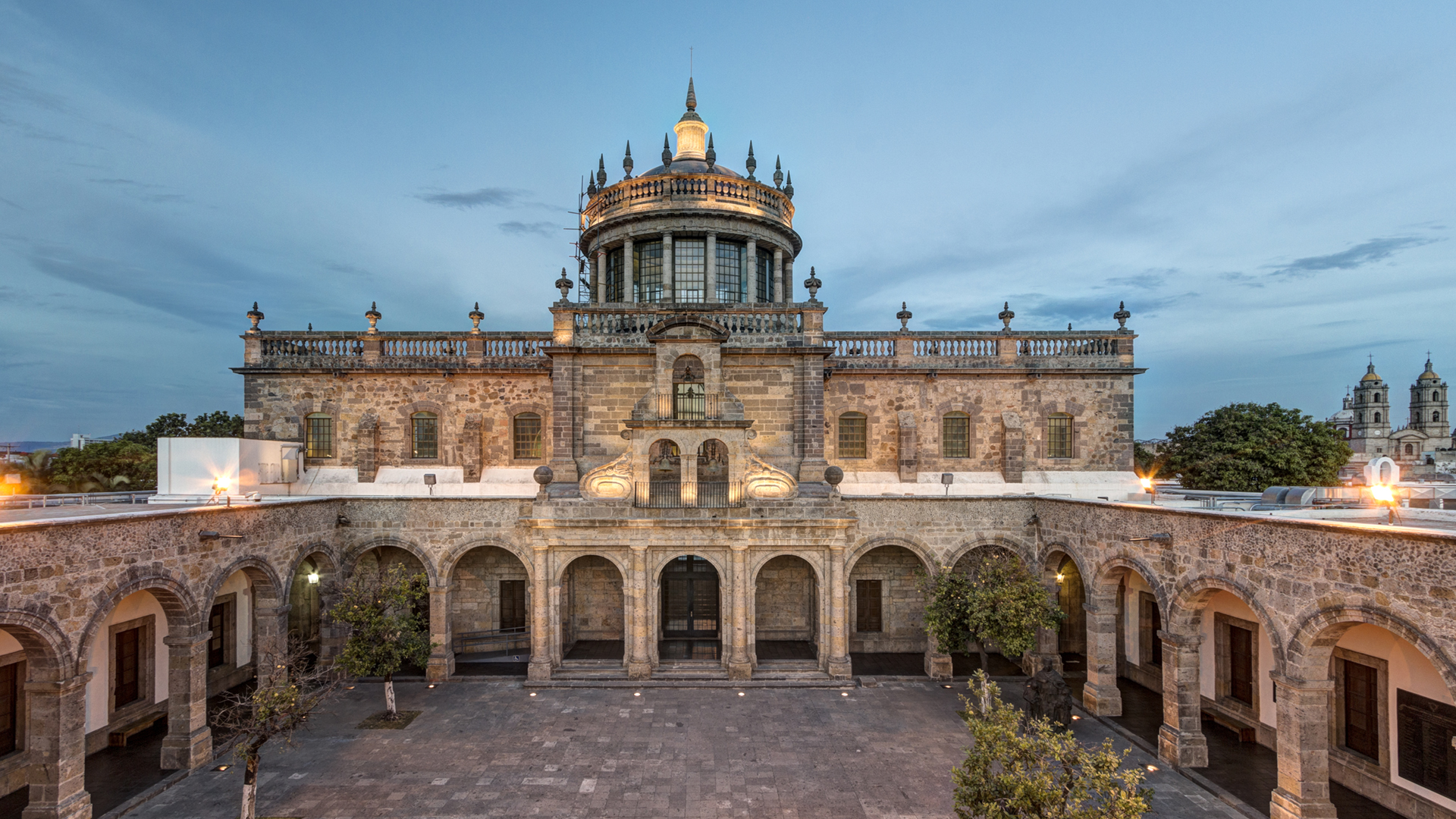

On the Guadalajara plain, the Hospicio Cabañas, now the Cabañas Museum, stands as one of the purest jewels of American Neoclassicism. Conceived at the end of the 18th century by Bishop Juan Cruz Ruiz de Cabañas y Crespo, it was designed by architect Manuel Tolsá, a Valencian genius who left behind works of precision and classical serenity in Mexico. His student José Gutiérrez directed the construction of the monumental building, which opened its doors in 1810 as the “House of Charity and Mercy.”
The complex—a single story covering 2.34 hectares—is striking for its balance of light, air, and proportion. Its rectangular layout of 23 interconnected courtyards, surrounded by Tuscan arcades, created an ideal environment for the orphans, elderly, and sick people it housed. The main chapel, crowned by a 32.5-meter dome, stands out as a symbolic and visual axis that articulates the complex.
The work embodies the enlightened ideals of functionality and humanity, an architecture that seeks to heal through space. Its sober façade, with six Doric columns and a smooth pediment, conceals a structural purity that has withstood centuries of history: barracks, orphanage, school, and, since 1983, museum.
Inside, the murals by José Clemente Orozco (1937-1939) transformed the chapel into a temple of creative fire. His monumental “Man of Fire” radiates movement and symbolism, elevating the site to the status of UNESCO World Heritage Site (1997).
Visiting the Cabañas Museum is like delving into the essence of Mexican architecture: rational, human, and deeply spiritual. It is a space where stone, art, and memory merge to silently tell the story of a country.
And receive exclusive information to travel through Mexico in style!