
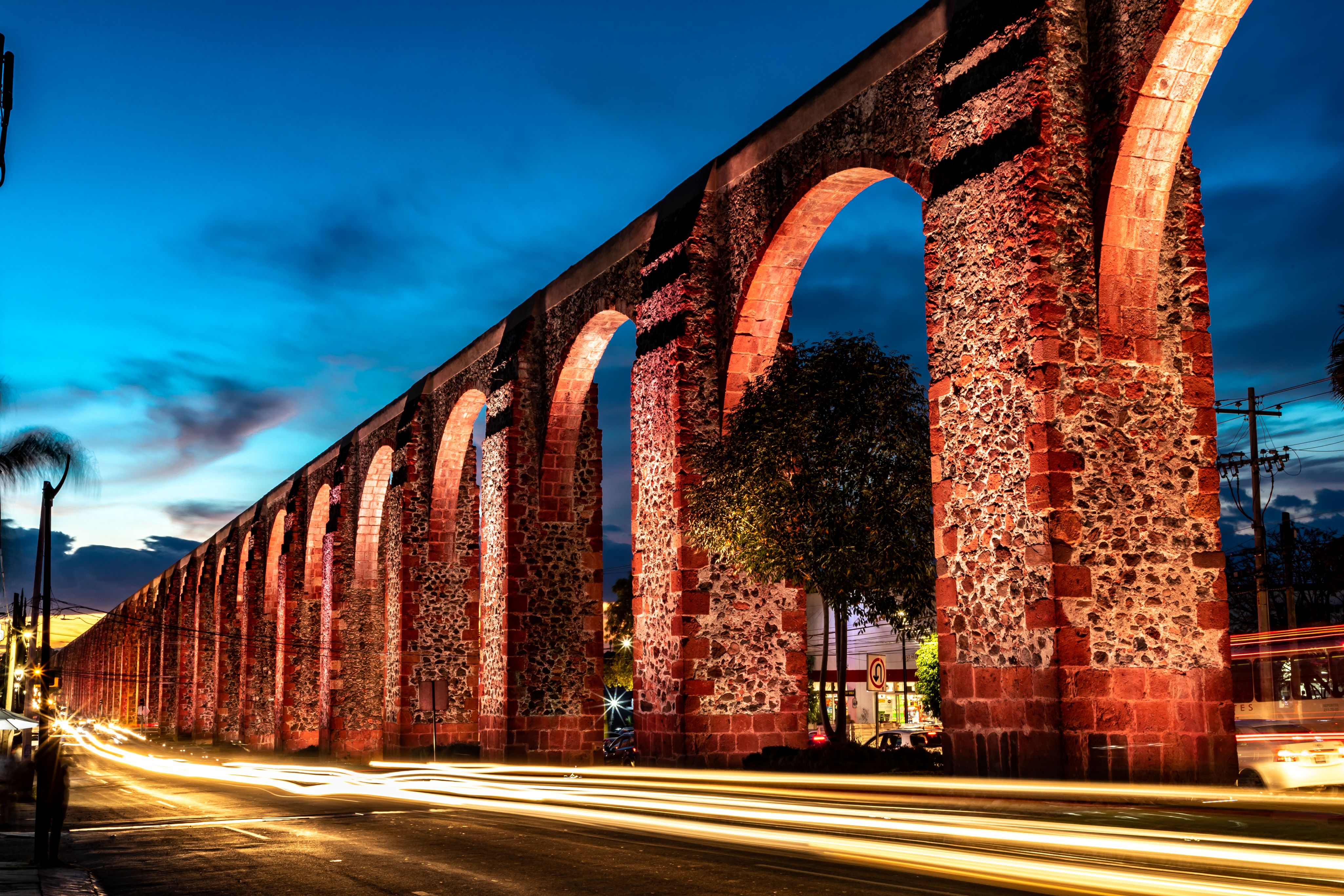

The journey begins with the Aqueduct, the undisputed symbol of the city. Its 74 arches, over twenty meters high, were built in the 18th century by the Marquis of Villa del Villar del Águila to bring water to the convent of La Cruz. Today, the Arches not only divide the view, but also unite the viceregal past with modern Querétaro.
In the heart of the Historic Center, the Temple of Santa Rosa de Viterbo captivates with its Baroque façade, designed by Ignacio Mariano de las Casas. Its dynamic curves, golden reliefs, and Arab-influenced tower make it a unique jewel of Mexican Baroque. Opposite it, the small square named after the architect invites visitors to contemplate the harmony between art and devotion.
A few streets away, the former Convent of San Agustín, now the Querétaro Art Museum, dazzles with its Baroque courtyard: Solomonic columns, cherubs, and floral reliefs that seem to move with the light. Nearby, the Casa de Ecala, with its ironwork and carved balconies, is one of the most elegant civil works of the 18th century.
The historical tour culminates at the Teatro de la República, the scene of decisive moments such as the promulgation of the 1917 Constitution. And to understand contemporary Querétaro, one need only visit the Congress Center, a venue with pure lines and clean geometries that dialogues with the Querétaro mountains.
Querétaro is an open-air museum where history and modern design coexist in perfect harmony..
And receive exclusive information to travel through Mexico in style!